Cutting Cost Per Qualified Lead by 19% to 44% With AI


Your paid channels are hitting their target cost per lead, but your sales team is rejecting half the pipeline. You are optimizing for form fills, but the real expense is hidden in wasted representative time and a plummeting conversion rate from lead to opportunity.
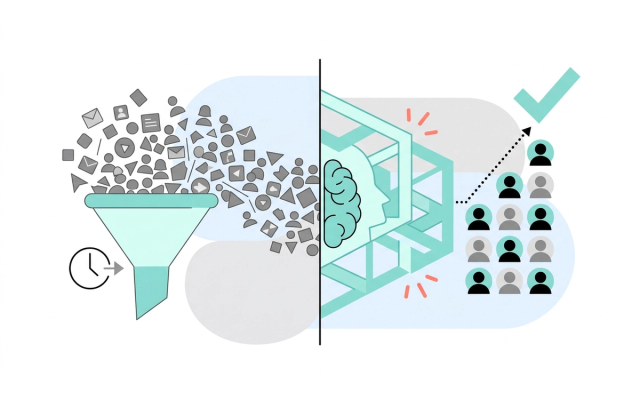
Automated AI lead qualification workflows reduce Cost Per Qualified Lead by 19% to 44% across paid channels. They achieve this by scoring intent before a human engages, then routing that qualification data directly back to ad platforms to train the bidding algorithms on quality rather than volume.
The trap of optimizing for volume
Paid advertising platforms like Google and Meta are exceptionally good at finding the cheapest possible conversion. If your conversion event is a top-of-funnel form submission, algorithms will efficiently locate prospects who happily fill out forms but never buy.
This creates a severe disconnect between marketing metrics and sales reality. Paid social carries an average cost-per-lead of $178, yet the true cost-per-opportunity balloons to $4,341 because only 4.1% of those raw leads convert, per LinkedIn B2B Institute 2026 data. By contrast, account-based marketing strategies carry a much higher initial cost of $487 per lead, but a 19.8% conversion rate drives the cost-per-opportunity down to $2,460.
Unfiltered volume is an expensive vanity metric. Top-quartile marketing programs utilizing intent layers and tighter scoring achieve an $84 cost per lead, while bottom-quartile programs relying on unfiltered volume pay nearly five times that amount, based on 2026 median benchmarks. Paying less for a raw lead almost always means paying more for a qualified meeting.
How automated scoring cuts CPQL
Introducing an AI workflow into this process fundamentally changes the economics of paid acquisition. B2B and trade service businesses deploying AI lead scoring models reduce their cost-per-qualified-lead by 31% to 44% within 90 days, according to 2024 Gartner research. Broader digital marketing benchmarks from 2026 put the baseline reduction at a more conservative 19%.
These savings materialize through a combination of speed and precision. A lead left waiting five minutes is 21 times less likely to convert than one receiving an immediate reply. Automated qualification software solves this delay by engaging prospects instantly through conversational interfaces. It scores them based on site behavior, intent signals, and budget constraints before a human representative ever opens the record. Replacing static forms with adaptive conversational AI qualification lifts qualified meeting bookings by 38% on the exact same traffic volume, and 62% of B2B websites will deploy conversational lead capture by late 2027, according to Forrester projections.
The most impactful cost reductions occur when this filtered data returns to the ad platform to influence targeting. This is exactly why SproutMe Execute continuously adjusts your bids, budgets, and audiences based on live performance data, rather than waiting for a weekly manual review. When algorithms are forced to optimize for the qualified meetings rather than the raw form fills, acquisition costs drop.
The volume threshold for AI models
AI scoring is not a universal fix. Machine learning systems rely heavily on pattern recognition, meaning they require a minimum threshold of data to distinguish a genuine buyer from a window shopper.
Intent-signal scoring models improve sales-qualified lead rates by 29% over manual workflows, provided the lead volume is high enough to produce reliable training data within 60 days, according to a 2024 study by Bart et al. in the Journal of Marketing Research. Conversely, AI scoring models actually underperform rule-based qualification for businesses receiving fewer than 25 leads per month, generating false-positive qualification rates above 40% due to insufficient training data, per 2024 McKinsey research.
If your paid channels do not generate enough daily volume to train a model in real time, you have to bridge the gap with historical data. You can learn How to Feed CRM Pipeline Stages Back to Google and Meta to seed your accounts with baseline qualification signals before activating your automated workflows.
Pure AI versus hybrid qualification
The temptation with automated lead qualification is to let the system handle the entire sequence from first touch to booked meeting. The data strongly suggests resisting that urge.
Pure-AI qualification programs operating without a human handoff produce a 41% lower meeting-to-opportunity conversion rate, based on 2026 benchmark studies from ZoomInfo and Cognism. AI is excellent at pattern matching and speed-to-lead, but it lacks the nuanced conversational agility required for complex discovery. A fully automated sequence often frustrates high-value prospects who expect a tailored conversation once they pass the initial screening.
The most efficient architecture is hybrid. When AI manages top-of-funnel sequencing, intent scoring, and basic filtering, while human representatives take over for the qualification and discovery calls, companies see their cost-per-meeting drop by up to 70%. You deploy the machine to do the filtering, protecting your sales team's calendar so they can do the selling.
Closing the qualification loop
To see these cost reductions on your paid channels, qualification data cannot stay trapped in your CRM. The true leverage of ai in digital advertising is not just generating creatives, but closing the feedback loop between CRM outcomes and ad platform bidding.
Every disqualified lead carries a vital negative signal. When you pass that signal back to Google and Meta, their native algorithms learn to suppress similar profiles in future auctions. This feedback mechanism is the architectural foundation of modern acquisition, and you can review How to Build AI Lead Generation Workflows for Paid Ads to map the exact data pipelines required to make it work.
By automating the qualification process and syncing the outcomes, you stop paying for the traffic your sales team never wanted in the first place.
Conclusion
Lead generation is a cost center until those leads become pipeline. By deploying AI to handle immediate response, intent scoring, and platform feedback, you strip the wasted spend out of your acquisition campaigns and protect your margins. See how SproutMe Plan turns your business priorities into a predictive cross-channel marketing plan before you commit a single dollar.
Frequently Asked Questions
Conversational AI is rapidly replacing static forms because it filters prospects in real time. Replacing traditional forms with adaptive conversational capture lifts qualified meeting bookings by 38% on the same traffic volume, and projections show 62% of B2B websites will use conversational lead capture by late 2027.
Fully automated systems excel at pattern matching and response speed but lack the conversational nuance required for complex discovery. Operating without a human handoff produces a 41% lower meeting-to-opportunity conversion rate. The most effective architecture pairs AI top-of-funnel filtering with human sales representatives.
Machine learning relies on pattern recognition, meaning it needs sufficient data to identify buyers. AI scoring models generate false-positive rates above 40% for businesses receiving fewer than 25 leads per month. You need enough weekly volume to build reliable training data, or historical CRM records to seed the model.


Get a complimentary audit to uncover AI opportunities hidden in your data.
Put these strategies to work