The Hidden Cost of Manual Lead Qualification and the AI Shift


Most businesses focus on generating more leads. Far fewer examine how those leads are evaluated once they enter the pipeline.
That oversight is expensive.
As marketing channels become more efficient, many companies are generating more inquiries than ever before. Yet sales teams often continue qualifying leads manually through CRM reviews, spreadsheets, form submissions, and individual judgment calls.
The result is a bottleneck that slows response times, creates inconsistent prioritization, and leaves revenue on the table.
The challenge isn't lead volume. It's identifying which opportunities deserve immediate attention.
This is where automated lead generation is evolving. Businesses are no longer focused solely on acquiring leads. They're investing in systems that help them qualify, prioritize, and convert those leads more effectively.
Why Manual Qualification Fails at Scale
Manual lead qualification works when lead flow is predictable and manageable.
The problem appears when growth starts accelerating.
As inquiry volume increases, sales teams face a constant stream of decisions. Which lead should be contacted first? Which prospect is actively evaluating solutions? Which inquiry is unlikely to convert?
Most teams answer these questions using limited information and subjective assessment.
A prospect who downloads a guide may receive the same priority as someone who has visited pricing pages three times, compared competitors, and booked a consultation request.
From a revenue perspective, those are not equivalent opportunities.
Research from InsideSales found that businesses responding within five minutes are significantly more likely to engage and qualify prospects than those waiting longer. Yet many organizations still rely on workflows that delay action until someone manually reviews the lead.
By the time that happens, the buyer may already be speaking with competitors.
The Revenue Leakage Most Businesses Miss
The true cost of manual qualification isn't employee time.
It's missed opportunity.
Every sales funnel contains a small percentage of prospects who are ready to make a purchasing decision. The faster those buyers are identified, the higher the likelihood of conversion.
Manual qualification makes this difficult because high-intent and low-intent leads often enter the same queue.
Without intelligent prioritization, sales teams spend valuable time sorting through contacts instead of engaging the prospects most likely to convert.
This creates a hidden form of revenue leakage.
Marketing teams continue investing in acquisition while conversion efficiency quietly declines.
It's often the same underlying issue explored in Why Your Leads Go Cold (It's Not What You Think). In many cases, prospects don't disappear because they lost interest. They disengage because businesses failed to recognize urgency when it mattered most.
How AI Improves Automated Lead Generation
The next generation of lead management is moving beyond static lead scoring and basic qualification rules.
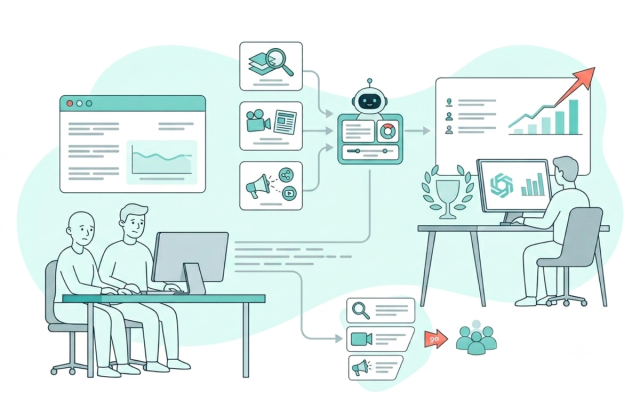
AI can analyze behavioral signals across the entire customer journey, including website activity, content engagement, email interactions, CRM history, and previous conversion patterns.
Instead of asking sales teams to guess which prospects deserve attention, AI identifies patterns that indicate buying intent.
For example, a prospect who returns to a pricing page multiple times, engages with product-specific content, and revisits your website over several days is demonstrating stronger purchase intent than someone who simply completes a contact form.
The same principle is shaping AI-powered search experiences.
When someone asks ChatGPT, "What's the best lead management solution for a growing business?" the AI doesn't rank websites the way traditional search engines once did. It evaluates authority, trust signals, reviews, comparisons, content quality, and brand visibility before generating recommendations.
Buyers now arrive with more information and clearer expectations. Qualification systems need to evolve accordingly.
Why AI Qualification Is a Competitive Edge
Search behavior is changing rapidly.
Industry research suggests that more than 60% of Google searches now end without a click, while AI-assisted search usage continues to grow across both consumer and B2B audiences. Buyers increasingly gather information through AI platforms before ever speaking with a sales representative.
This changes the role of qualification.
Businesses can no longer assume every lead enters the funnel at the same stage of awareness. Some prospects are exploring. Others are already comparing vendors and preparing to buy.
The companies gaining an advantage are the ones using AI to identify those differences early.
When automated lead generation is paired with intelligent lead qualification, sales teams can focus their effort where it produces the greatest impact. That improves conversion efficiency, shortens sales cycles, and increases return on marketing investment without requiring additional lead volume.
Conclusion
Manual lead qualification isn't just a process problem. It's a growth constraint.
As customer journeys become more complex and AI-driven search influences more buying decisions, businesses need systems capable of identifying intent faster than manual workflows allow.
The organizations outperforming their competitors aren't necessarily generating more leads. They're making better decisions about the leads they already have.
Why High-Intent Buyers Still Slip Away
If your pipeline is full but conversions remain inconsistent, the issue may not be lead quality. It may be your ability to identify and prioritize buying intent quickly enough.
SproutMe's AI-powered lead management solutions help businesses combine automated lead generation with intelligent qualification, ensuring the right opportunities receive attention before they become missed opportunities.
Frequently Asked Questions
Manual lead qualification is the process of evaluating leads using human review, typically based on forms, CRM records, demographics, and sales team judgment.
As lead volume increases, manual qualification creates delays, inconsistent prioritization, and a higher risk of missing high-intent opportunities.
AI analyzes behavioral signals such as website visits, content engagement, email activity, and historical conversion data to identify prospects with stronger buying intent.
Lead generation focuses on attracting potential customers, while lead qualification determines which prospects are most likely to become paying customers.
Yes. By helping businesses identify and engage high-intent prospects faster, AI-powered qualification can improve response times, increase sales efficiency, and support higher conversion rates.



Get a complimentary audit to uncover AI opportunities hidden in your data.
Put these strategies to work