Spending on Ads but Not Seeing Sales? Here's What's Actually Broken

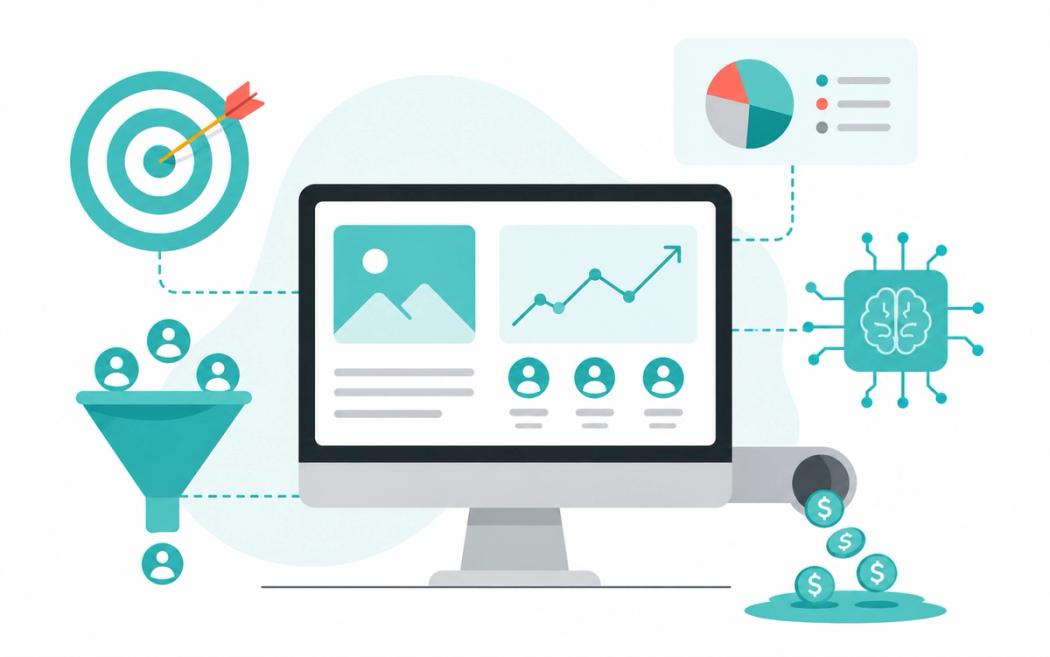
You've set up the campaigns. Written the copy. Picked an audience. Hit publish. Watched the money leave your account.
And then silence. A few clicks. Maybe a scattered lead or two. But not the sales, not the pipeline, not the return you were promised.
If this describes your last quarter, you are not alone and you are not the problem. The problem is almost always hiding in plain sight: a broken system that most ad platforms are financially incentivized not to fix, and that most traditional agencies are not equipped to diagnose.
This article will not tell you to spend more on ads. It will show you why your current spend is not working and what a modern AI ads agency approach actually does differently.
Scale of the Problem Is Bigger Than You Think
Let's start with some uncomfortable math.
With digital ad spending reaching $790 billion globally as of 2025, even modest waste percentages translate to massive losses. A company spending $100,000 annually on digital ads could be throwing away $30,000 without even realizing it.
According to a 2025 Lunio report analyzing 2.7 billion clicks across six major ad platforms, TikTok showed an average invalid traffic rate of 24.2%, while LinkedIn came in at 19.88% and X at 12.79%. That means nearly one in four clicks on certain platforms is not a real person with buying intent. It is a bot. And your campaign is paying for it.
Research also suggests that roughly 41% of overall ad spend goes to waste industry-wide. When you combine invalid traffic, poor targeting, misaligned landing pages, and vanity-metric-obsessed campaign structures, the average business is working with barely half the firepower they think they have.
The question is not whether your ad spend is being wasted. The question is where it is bleeding, and why.
5 Reasons Your Ads Are Spending Without Selling
1. You Are Measuring the Wrong Things
Most campaigns are optimized for clicks, impressions, and cost-per-click. These are easy numbers to show in a dashboard. They make reports look impressive. But they have a deeply problematic relationship with the metric that actually matters: revenue.
Here is a simple example. A SaaS company running Google Search ads pulls a 4.8% click-through rate, well above the industry average. The account manager sends a glowing update. But the landing page conversion rate is 0.9% and the average deal size is $200. After platform fees and management overhead, they are spending $180 to acquire a $200 customer. The campaign looks healthy. The business is slowly bleeding.
A $100,000-per-month campaign with just 20% waste loses $240,000 annually. Worse, wasted spend trains platform algorithms on the wrong signals, creating a negative feedback loop where targeting gets progressively worse over time. Every dollar you spend optimizing for the wrong conversion signal teaches the algorithm to find more of the wrong audience.
Fix: Define revenue-linked KPIs from day one. Cost per acquisition (CPA), return on ad spend (ROAS), and customer lifetime value (LTV) relative to acquisition cost should govern every decision, not click volume or reach.
2. Your Targeting Is Broadly Wrong
There is a myth in paid advertising that casting a wider net means more opportunities. In reality, it usually means more dilution, more irrelevant impressions, and higher costs for lower returns.
Consider this scenario: a premium fitness coaching brand targets "fitness enthusiasts, ages 25 to 55, interested in health." That audience on Meta could be 40 million people. But their actual buyers are female professionals aged 32 to 45 who have tried multiple programs and respond to messaging about time efficiency. That might be 800,000 people, and they convert at seven times the rate of the broad group.
Switching from engagement objectives to sales objectives with properly refined targeting can mean the difference between a campaign running at a loss and one generating 442% ROI on the same budget.
3. Your Landing Page Breaks the Ad Promise
Your ad is a promise. It says: click here and you will get X. Your landing page is where that promise is either kept or broken. If there is any gap in tone, messaging, speed, or offer clarity, the user leaves and does not come back.
If your ad says "Get 20% off your first order," your landing page must open with exactly that message, not "Welcome to our store." Ad-to-page message match is everything. A professional services firm that fixed this saw 375% more leads on the exact same ad spend.
Page speed compounds this problem. A one-second delay in mobile load time can reduce conversion rates by up to 20%. If your page takes four seconds to load on a phone, you may be losing the majority of potential conversions before the user even sees your offer.
4. You Have No Retargeting Strategy
97% of first-time website visitors do not convert. Without a structured retargeting funnel, you are losing all of them.
The vast majority of people who click your ad are not ready to buy on first encounter. They are researching, comparing, getting interrupted by life. If your ads stop appearing after that first touchpoint, a competitor who does retarget them will close that sale.
A well-designed retargeting strategy layers messaging based on behavior: someone who viewed a pricing page gets a different message than someone who only read a blog post. Someone who added to cart but did not purchase gets an urgency-based offer. An e-commerce brand that implemented a full retargeting funnel saw 100% ROAS improvement from retargeting alone, with no increase in cold traffic spend.
5. Tracking Gaps Are Making Your Campaigns Blind
iOS privacy changes, third-party cookie deprecation, and ad blockers have created massive signal gaps between what platforms report and what is actually happening. Between 20 and 30% of iOS conversion events are lost to App Tracking Transparency restrictions. When your tracking is incomplete, the algorithm is working with corrupted data and making optimization decisions based on a fraction of actual conversions.
A B2B company that fixed their tracking issues discovered their campaigns were already three times more profitable than reported. They had been about to kill campaigns that were quietly working.
Why Traditional Agencies Struggle to Fix This
Most traditional agencies were built for a world where manual bid adjustments and monthly reporting cycles were sufficient. That world ended.
Google's Performance Max, Meta's Advantage+, and similar systems now make thousands of micro-optimization decisions per second that no human can monitor or replicate manually. This means agency value can no longer be tactical. It must be strategic.
The questions that drive performance in 2026 are: What signals are we feeding the algorithm? What is our true cost per profitable customer? How are we structuring creative across multiple touchpoints? Are we measuring incrementality, not just last-click attribution?
Traditional agencies often lack the analytical infrastructure to answer these questions. They are also typically structured around billable hours and platform spend percentages, incentive structures that do not always align with the client's actual goal of maximizing return.
What an AI Marketing Agency Does Differently
A modern AI ads agency is not simply an agency that uses AI tools. It is a fundamentally different operating model built around data infrastructure, predictive intelligence, and continuous machine-guided optimization.
Predictive Audience Intelligence: Rather than relying on static demographic filters, AI-driven campaigns build dynamic audience models that continuously update based on who is actually converting. If your highest-LTV customers share a cluster of behavioral signals, an AI system can identify and target look-alike audiences at a speed that manual methods cannot match.
Real-Time Creative Optimization: Human creative teams test ads in cycles. AI-driven optimization operates continuously, identifying within hours which creative variations are performing against specific audience segments and reallocating budget toward winners dynamically.
Closed-Loop Attribution: Rather than accepting platform self-reported attribution data, sophisticated AI marketing agencies implement multi-touch attribution models that account for the full customer journey. This is how you discover that a LinkedIn campaign looking expensive on a cost-per-lead basis is actually generating customers with three times the LTV of your Google Search customers.
Algorithmic Budget Management: AI-powered budget systems continuously reallocate spend based on real-time performance data, shifting budget away from underperforming placements and toward what is actually delivering profitable conversions. This is not something a human account manager reviewing weekly reports can replicate.
Among advertisers in 2026, cost efficiency has become the top cited benefit of AI in advertising, referenced by 64% of respondents, up significantly from its fifth-place ranking just two years prior.
The Metrics That Actually Tell the Truth
Most dashboards are designed to make campaigns look successful. They foreground CTR, reach, and impressions. Here are the metrics that actually matter:
ROAS (Return on Ad Spend): Revenue generated per dollar spent. A ROAS of 3x means every dollar spent generates three in revenue. Always understand this number relative to your actual profit margins.
CPA (Cost Per Acquisition): What you pay, on average, to acquire one customer. Always compare this against average order value and LTV, never in isolation.
LTV:CAC Ratio: The ratio of customer lifetime value to customer acquisition cost. A healthy ratio is generally 3:1 or higher. Below 2:1 typically indicates the business cannot sustain paid acquisition at current economics.
Incrementality: The true measure of what your ads are actually causing, not just correlating with. Incrementality tests reveal how many conversions would have happened anyway without your ads. It is the most honest metric and the least commonly implemented.
The Problem Is the System, Not the Budget
If you have been spending on ads without the sales to match, the issue almost certainly is not that digital advertising does not work for your business. It is that the system running your advertising is broken in one or more of the ways described above, often quietly, in ways easy to miss when you are staring at a dashboard full of green numbers.
Every one of these problems is diagnosable and fixable. Broken tracking can be repaired. Landing pages can be rebuilt. Targeting can be refined. Retargeting funnels can be built from scratch.
What changes the outcome is not spending more. It is building the infrastructure to know what is actually working and having the analytical firepower to act on that knowledge faster than the competition.
That is the core promise of working with a true AI ads agency: not just tools that automate what humans do, but an operating model that makes better decisions, learns faster, and continuously compounds your return on every dollar you invest.
The ads are not broken. The approach is. And that is entirely fixable.
Ready to stop guessing and start measuring what actually drives revenue? The first step is an honest audit of your current campaign structure, attribution setup, and conversion architecture.
Frequently Asked Questions
Clicks without sales usually point to one of three problems: your landing page is not delivering on the promise the ad made, your audience targeting is too broad and attracting people with no real buying intent, or your retargeting setup is missing entirely and you are losing 97% of first-time visitors permanently. The click is rarely the problem. What happens after the click is where most campaigns fail.
Industry research suggests roughly 41% of overall ad spend goes to waste across the digital advertising ecosystem. For an individual business, the number depends on platform mix, targeting precision, and tracking infrastructure. Businesses without proper conversion tracking, retargeting, and audience segmentation can easily be wasting 30 to 50% of their budget on clicks that were never going to convert.
A traditional agency manages campaigns manually, reviewing performance in weekly or monthly cycles and making adjustments based on human judgment. An AI ads agency builds systems that optimize in real time, processing thousands of data signals per second to adjust bids, audiences, and creative allocation continuously. The core difference is speed, scale, and the ability to identify patterns in audience behavior that no human analyst could surface manually.
The clearest signals are: your ROAS has been flat or declining despite increasing spend, your agency reports look healthy but your revenue does not reflect it, you have no visibility into which specific touchpoints are actually driving conversions, or your campaigns are running without a structured retargeting funnel. If any of these apply, the current approach has likely hit its ceiling and a more data-driven model is worth exploring.
Some fixes show impact quickly. Landing page improvements and retargeting setup can produce measurable conversion lifts within two to four weeks. Fixing tracking infrastructure tends to show results within the first month as the algorithm starts receiving cleaner signals. Audience refinement and creative optimization typically take four to eight weeks for the platforms to exit the learning phase and stabilize at improved performance. The full compounding effect of a well-structured AI-driven campaign generally becomes clear in the 60 to 90-day window.


Get a complimentary audit to uncover AI opportunities hidden in your data.
Put these strategies to work