Why Is Delaying AI Adoption Your Biggest Business Risk?


Marketing agencies face constant pressure to improve results while controlling costs. Yet many still rely on manual workflows because AI adoption appears expensive or complex. However, delaying AI comes with hidden costs. Manual processes reduce productivity, increase human error, and slow business decisions. For a 20-person marketing agency, manual client reporting and lead intake can cost up to $775,740 annually in lost capacity, error correction, and missed revenue. As competitors leverage AI to improve efficiency and profitability, agencies that delay adoption risk falling behind. Understanding the true opportunity cost of manual workflows is essential for building a sustainable, competitive agency. This article explores why delaying AI is a costly strategic mistake and how agencies can adopt it with confidence.
The Hidden Cost of Manual Workflows
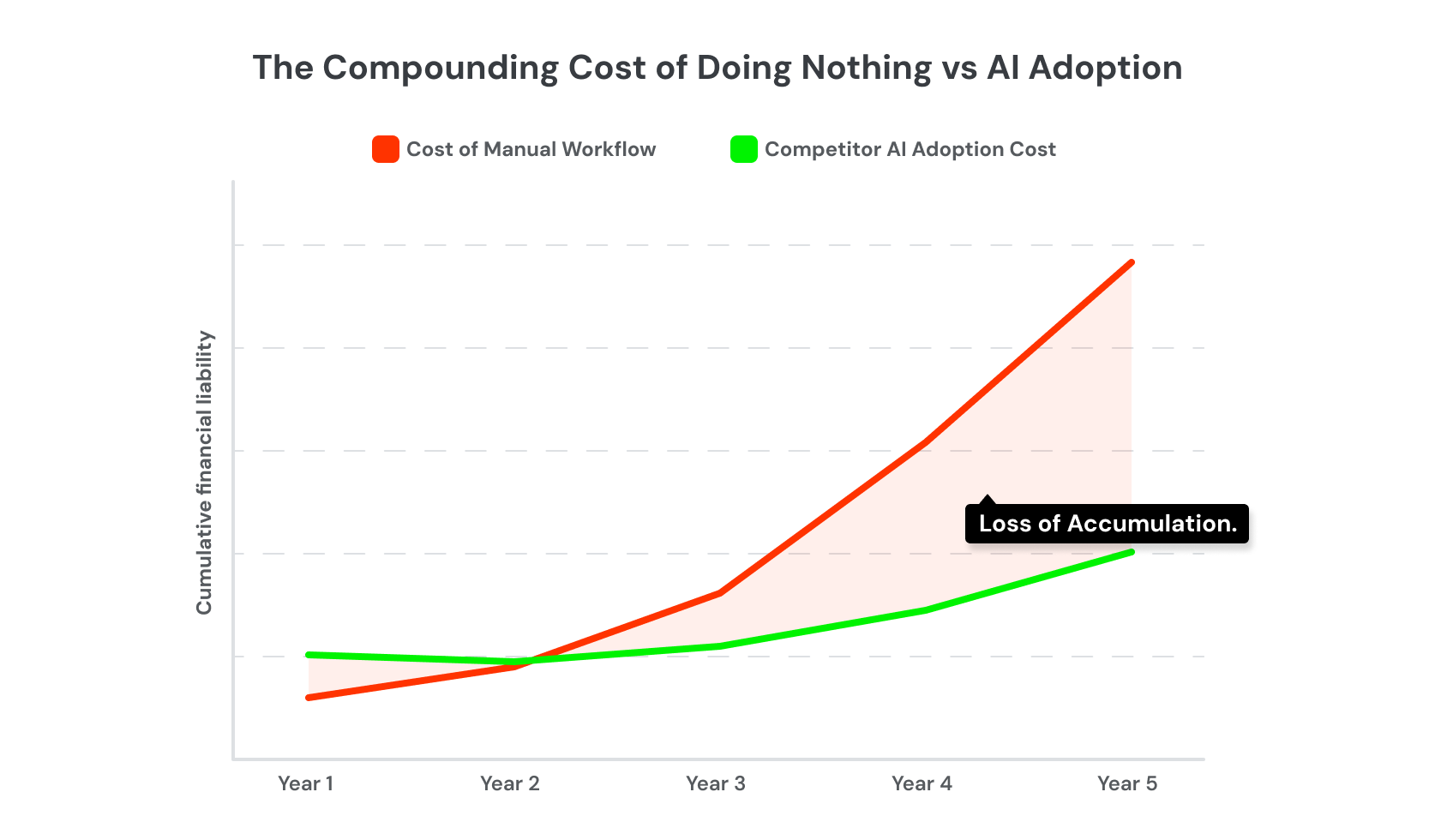
Sticking with manual workflows creates a compounding financial liability that grows over time. To build a strong case for AI adoption, agencies must calculate the true Opportunity Cost of Manual Workflows. However, standard models often underestimate these costs by 3 to 5 times because they rely on labor-hour calculations and overlook hidden multipliers such as the Fully-Loaded Rate, Context Switching Tax, and Talent Burnout & Attrition.
Total Cost of Manual Friction (TCMF)
This framework breaks this calculation down into three core pillars:
- Pillar 1: Labor Capacity Recoverable Cost: Instead of framing AI adoption around headcount elimination, focus on capacity recovery and redeployment. High-growth agencies rarely cut staff post-AI adoption; instead, they scale their capacity to handle more clients.
- Pillar 2: The Compounding Error Cascade Cost: Human error is a structural feature of manual workflows. Industry benchmarks confirm that manual data handling suffers from a 1% to 5% field-level error rate. These errors cascade downstream, multiplying costs exponentially.
- Pillar 3: Lost Revenue of Delayed Response (The Speed Tax): In lead generation, response speed directly impacts conversions. Responding to an inbound lead within 5 minutes achieves a 78% conversion-to-opportunity rate, while a one-hour delay reduces it to 36%. Additionally, manual sales processes leave up to 77% of inbound leads unanswered.
The Core Opportunity Cost Formula
Once the individual friction points are mapped, they must be plugged into the classic economic opportunity cost formula to compare sticking with manual processes versus adopting AI-driven automation:
Opportunity Cost = Return on Foregone Option (AI Adoption) - Return on Chosen Option (Sticking Manual)
The Compounding Risk of Delay
The cost of doing nothing is dynamic, not static. While a firm delays, three forces actively compound the liability:
- Wage and Talent Inflation: As fully loaded employee costs rise, the cost of manual workflows increases proportionally.
- Competitive Margin Divergence: Competitors who scale intelligent AI automation experience an average 32% operational cost reduction. They actively reinvest these savings into client acquisition, lowering their Customer Acquisition Cost (CAC) and pricing out manual agencies.
- Data Quality Degradation: Manual systems fail to build the clean, structured data assets that train proprietary AI models. Every quarter a firm delays is a quarter of lost data accumulation, widening the structural gap.
For marketing agencies and lead generation businesses, competing on speed, accuracy, and profitability is impossible with manual workflows. Calculating the Total Cost of Manual Friction is more than an accounting exercise. It is the roadmap to long-term competitiveness and survival.
Why Waiting Makes AI Adoption More Expensive
The AI learning curve is steepening rapidly, making early adoption more valuable than ever. As organizations gain experience, they build reusable workflows, tools, and knowledge that accelerate future AI implementation, creating a competitive advantage that late adopters struggle to match. However, delaying AI poses several compounding risks:
- Compounding Data Debt: Waiting to build a "perfect" data foundation is a trap. Delaying AI adoption accumulates messy data that becomes exponentially more expensive to remediate.
- Operational and Financial Leakage: A 15% productivity gap caused by delayed automation costs mid-sized firms $1.1 million to $1.5 million annually in lost efficiency, while early adopters achieve 7 to 8 times greater financial benefits over five years.
- Shadow AI Risks: 78% of employees use ungoverned AI tools, increasing data exposure and compliance risks. Gartner predicts that by 2030, 40% of enterprises will experience security incidents due to unmanaged Shadow AI.
To maximize early value, organizations should focus on AI operationalization, shifting effort from administrative tasks to strategic decision-making.
How to Adopt AI Without Overspending
For marketing agencies, delaying AI adoption is a strategic risk. McKinsey reports that early adopters gain advantages in efficiency, content scaling, and client satisfaction, while Google Cloud found that generative AI users achieved over 6% year-over-year revenue growth. However, AI platforms use variable, usage-based pricing, increasing financial risks. According to WitnessAI, 68% of U.S. companies experienced AI cost overruns, and only 9% of executives reported that over three-quarters of their AI initiatives delivered measurable financial returns. To stay competitive without risking profitability, agencies need systematic, risk-mitigated AI testing frameworks.
The following are some steps to mitigate risk:
Step 1: Mitigating Budgetary Pitfalls through Practical AI Cost Governance
Traditional budgeting often fails for generative AI because usage-based costs, such as API calls, token consumption, and context window expansion, can escalate quickly. Agencies should implement API spending caps, budget thresholds, and continuous monitoring to prevent runaway costs. They should also eliminate Shadow AI by centralizing AI tools under Single Sign-On (SSO) and Multi-Factor Authentication (MFA). According to IBM's Cost of a Data Breach research, one in five organizations experienced breaches due to Shadow AI, with an average of $670,000 in additional breach costs.
Step 2 : Utilizing Quantitative Risk-Based Testing (RBT)
To avoid wasting hundreds of billable hours on software testing with minimal ROI, agencies should adopt a quantitative Risk-Based Testing (RBT) framework. Rather than spending weeks evaluating non-essential features, RBT helps agencies prioritize critical areas and focus their limited testing resources where they deliver the greatest strategic value.
Step 3 : Implement the BXT Pilot Model Before Scaling
Agencies can minimize financial risk by replacing organization-wide rollouts with isolated departmental pilots, an approach known as the Safe Start methodology. Before scaling a platform, agencies should evaluate it using the BXT Scoring Model:
Business Value (B), which measures improvements in conversions, task completion time, and client acquisition costs;
Experience Impact (X), which assesses its effect on team workflows; and
Technology Feasibility (T), which determines whether the agency has the data quality, infrastructure, and technical capabilities to support it. Testing on a single low-risk campaign allows agencies to measure performance, gather feedback, and calculate ROI before expanding adoption.
Step 4 : Leverage Third-Party Risk Management (TPRM)
When testing new AI tools, agencies must protect client data through robust third-party risk management (TPRM). They should ensure that client assets and proprietary data are not used to train public AI models, strengthen vendor contracts with data transparency and legal indemnities, and establish AI incident response protocols. According to the Interactive Advertising Bureau (IAB), 70% of marketers have experienced AI-related incidents, with 40% of affected brands pausing or withdrawing campaigns, highlighting the need for content moderation and human oversight.
Delaying platform adoption in a hyper-competitive market is a significant risk, but uncontrolled experimentation can reduce profitability and harm client relationships. By implementing cost governance caps, quantitative risk-scoring metrics, limited BXT pilots, and robust third-party risk management, marketing agencies can confidently adopt AI platforms while maintaining financial control.
Consequences of not adopting early to AI:
- Weakened Employer Brand: Being perceived as a technological laggard weakens an organization's employer brand. Candidates increasingly use AI tools like ChatGPT, Claude, and Gemini to evaluate employers. Outdated technology and poor digital presence lead to unfavorable AI-generated reviews, causing companies to lose candidates before the hiring process even begins.
2. Higher Hiring Costs: A poor employer reputation forces organizations to pay a wage premium. Studies show that companies with weak employer brands must offer at least a 10% higher salary, averaging $4,723 more per hire, which can scale to $7.6 million annually for large organizations.
3. Increased Employee Turnover: Outdated workplace technology drives employee attrition. 20% of Gen Z employees have quit jobs because of poor workplace technology, while 49% would consider leaving for the same reason. As AI-driven workloads increase, 23% of organizations report chronic stress, and businesses lacking modern tools experience a 51% decline in productivity.
To protect their talent funnel, marketing agencies and lead gen businesses must optimize their online presence for Generative Engine Optimization (GEO), leverage specific skills-first hiring descriptions, and support a blended human-AI growth culture.
Conclusion
AI adoption is no longer a choice but a strategic necessity for marketing agencies. While delaying adoption increases operational costs, competitive disadvantage, and talent challenges, a structured approach enables agencies to manage financial risks with confidence. By embracing AI early and implementing robust governance frameworks, agencies can improve efficiency, strengthen profitability, and secure a sustainable competitive advantage.


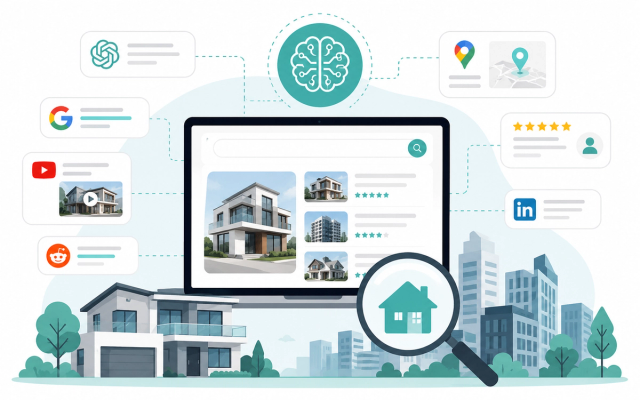

Get a complimentary audit to uncover AI opportunities hidden in your data.
Put these strategies to work