How AI Changes the Agency Operating Model


Your agency growth currently depends on headcount, which breaks your balance sheet. Every five complex accounts you win requires hiring another media buyer, tying your revenue ceiling directly to your payroll expenses. You know the manual model is unsustainable, but pushing more accounts onto your existing team guarantees performance drops.
To scale revenue without proportional headcount, you have to transition from a manual workflow to an agent-led operating model. When you transfer the recurring operational load to AI, your strategists can direct a wider portfolio of accounts without sacrificing delivery quality or profit margins.
Expanding Agency Profit Margins
Agencies implementing AI-driven campaign automation typically see gross margins expand by five to 10 percentage points. The improvement comes from recovering non-billable hours previously lost to routine reporting and campaign setup, reducing your overall cost of delivery. Read our complete analysis on How AI Expands Marketing Agency Profit Margins.
The flaw in agency economics
The business model of a digital marketing agency is essentially arbitrage on specialised labour. Labour costs are consistently the largest expense on the profit and loss statement, typically consuming between 50% and 70% of total revenue. Because wages are fixed but daily output is variable, profitability is highly sensitive to delivery efficiency.
Agencies target a billable utilisation rate between 70% and 80%, but manual administrative work and unmanaged scope creep frequently drag that figure down closer to 60%. The math on a standard monthly retainer is unforgiving. If a client pays a fixed fee and delivery relies on intensive manual work from a senior strategist, the gross margin is tightly capped. You can't continually raise prices to compensate for operational inefficiency. The only viable path to higher net profit is reducing the hours required to deliver the exact same outcome.
Where manual delivery leaks margin
Margin leaks in a performance agency are rarely strategic failures. They are operational bottlenecks that consume high-value practitioner time. Friction begins immediately during client onboarding. Collecting brand assets, establishing CRM connections, configuring tracking pixels, and aligning on tone of voice require constant back-and-forth communication. When handled manually, these steps delay campaign launches by weeks, deferring revenue before marketing even begins.
Once a campaign is live, the recurring drain shifts to reporting and daily maintenance. Extracting data from Google Ads, Meta, LinkedIn, and a third-party analytics platform to compile a cross-channel monthly report takes hours per client. Across a portfolio of 20 accounts, an agency loses hundreds of hours every month simply formatting metrics to tell clients what happened last week. This reporting cycle doesn't improve campaign performance; it just taxes the margin. Beyond reporting, basic bid pacing requires someone to log into multiple ad managers, check the spend against the target, and adjust daily limits. Having an expensive human practitioner click these buttons is a fundamental misallocation of resources.
The limits of dashboard automation
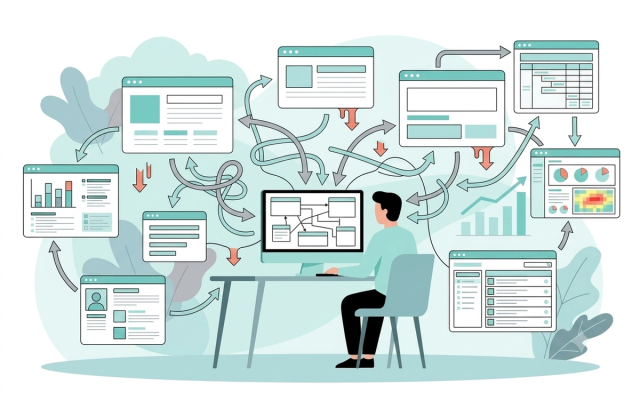
Many agencies attempt to solve margin compression with basic workflow automation. Connecting a web form to a project management tool speeds up onboarding, and pulling raw metrics into a dashboard saves a strategist from downloading flat files. While helpful, these workflows only present information. They do not execute.
A rule-based alert might tell a media buyer that a campaign is pacing behind its target, but it doesn't tell them what to do next. The system can't diagnose whether the failure was caused by stale creative, an overly broad audience, or aggressive competitor bidding. The human buyer still has to interpret the dashboard, formulate a new approach, log back into the ad platforms, and make the adjustments manually. The operational load remains firmly on the agency team, meaning the capacity ceiling has barely moved. Rules and scripts merely alert humans to problems; they do not assume the responsibility of solving them.
Moving to agentic execution
The structural shift happens when agencies replace static workflows with agentic execution. Instead of triggering an alert for a human to review, an AI agent encodes actual channel expertise to run the optimisation loop end to end. An agent monitors auction dynamics, adjusts bids, rotates fatiguing creative, and reallocates budgets across platforms in real time.
We built SproutMe Execute specifically for this transition, allowing agents to launch and continuously adjust live campaigns within your defined spend limits and scope guardrails. When the system handles the high-frequency execution based on real performance data, the agency team focuses entirely on strategy and client communication. Expanding margins through this kind of automation isn't about cutting staff. It is about reallocating the hours your team already works toward high-leverage, billable activities. If automation recovers 10 hours of manual labour per month on a standard retainer, the agency's delivery cost drops while the fee remains unchanged. That resulting gap is pure margin.
Retention as a margin multiplier
Acquiring a new agency client is expensive, and replacing a churning one eats directly into net profit. A massive secondary benefit of automating operational plumbing is output consistency. Agencies frequently lose clients after a year not because the return on ad spend was terrible, but because communication was inconsistent and reporting was late.
When reporting is delivered precisely on time, insights are clear, and optimisations happen continuously rather than waiting for a weekly review, client satisfaction stabilises. Consistent communication extends the average client lifespan. Retaining a client for longer effectively doubles their lifetime value without incurring a second acquisition cost. When revenue scales on top of a flat cost structure, and client churn drops because the operational output is finally reliable, the financial profile of the agency transforms. The resulting margin expansion gives the founders capital to reinvest in senior talent or confidently drop lower-tier accounts.
Multiplying Strategist Capacity
Shifting the operational load to AI agents fundamentally changes how many clients a single team member can manage. Instead of manually executing tasks, senior buyers direct a wider portfolio of accounts operating within strict guardrails. See the exact breakdown of Multiplying Agency Account Capacity With AI Agents.
The rigid limit on manual accounts
Agency account capacity is governed by the basic math of a working week. Under a purely manual management model, the routine maintenance of a single client account consumes hours of practitioner time before any strategic work occurs. A media buyer managing active campaigns across multiple platforms spends their week cycling through identical operational loops. Monday mornings are lost to pacing checks and data aggregation. Mid-week hours disappear into granular bid adjustments, audience exclusions, and testing creative variants.
Because this workload scales linearly, the capacity ceiling for a human buyer is rigid and low. While simplified local campaigns might allow a manager to carry a slightly larger roster, complex enterprise accounts require deep daily involvement. Pushing a buyer past this natural threshold guarantees that performance will degrade. Pacing goes unmonitored, ad fatigue sets in unnoticed, and the agency transitions from actively optimising the account to simply keeping the lights on.
Platform tools optimize inward
As agencies try to scale, they frequently lean on platform-native AI features like Google Performance Max or Meta Advantage+. These tools are genuinely good at optimising, but they operate strictly within their own walled gardens. Platform-native algorithms are designed to maximise performance on their respective networks, which naturally aligns with the platform's own revenue interests.
These algorithms require significant data volume — typically 30 to 50 conversions a month — to function effectively, and they will never advise an agency to shift budget to a competing network. If Meta is underperforming and Google search demand is surging, neither platform will coordinate the shift. This leaves the highest-leverage decision in performance marketing — cross-channel budget allocation — entirely on the shoulders of the human media buyer.
The cross-channel allocation edge
To genuinely multiply capacity, agencies need automation that works across boundaries. Third-party AI tools approach budget allocation differently, sitting above the individual ad accounts to pull data cross-channel and optimise based on overall business goals. Rather than optimising within the confines of individual platforms, these systems dynamically reallocate advertising budgets in real time by leveraging models that process live performance data and shifting market dynamics.
Enterprise-grade budget allocation systems consistently demonstrate double-digit reductions in customer acquisition costs by eliminating inefficient spending while maintaining overall conversion volume. By removing the need for a strategist to manually reconcile performance across Google, Meta, TikTok, and LinkedIn before making a budget decision, cross-channel AI systematically reduces wasted ad spend. The machine shifts the funds toward the campaigns delivering the highest returns, allowing the human strategist to oversee a much larger total ad spend without increasing their weekly hours.
Safe autonomy requires guardrails
The primary objection to operating at a high account-to-employee ratio is the fear of losing control. An agent that optimises aggressively but lacks business context will efficiently acquire the wrong customers, burning client budgets on cheap conversions that never generate revenue. Autonomy is only safe when it is strictly bounded.
True scaling requires grounding the execution layer in the specific realities of each client. An agent must understand the difference between a high-volume consumer brand and a complex enterprise software product. To solve this, we built SproutMe Knowledge so every client's brand guidelines, tone of voice, positioning, and ideal customer profiles are held per individual workspace. The agents draw on this specific context before making decisions, ensuring that cross-channel execution remains tailored to the client. The human sets the strategy and the financial boundaries; the agent handles the high-frequency execution within those exact limits.
Redesigning the agency pyramid
When the operational load of campaign management is transferred to an AI workspace, the fundamental structure of the agency team changes. The traditional model relies on a heavy base of junior and mid-level buyers executing tasks, overseen by a smaller number of senior strategists. Agent-led execution flips this pyramid.
Instead of hiring another media buyer for every handful of new accounts, an agency can scale its client roster around a leaner team of highly experienced strategists. Their daily routine shifts from pulling levers in ad platforms to reviewing agent proposals, refining cross-channel strategies, and managing high-level client relationships. Because the repetitive execution is handled systematically, these senior practitioners can comfortably direct a portfolio of accounts that is several multiples larger than a traditional manual workload. This ensures that your newest account receives the exact same standard of optimisation as your oldest, decoupling headcount from revenue and securing your long-term profitability.
Conclusion
To protect your margins and scale your agency without burning out your team, you have to disconnect your revenue capacity from manual headcount. Platform-native tools and basic rule scripts only offer minor relief because they leave the cross-channel allocation and execution firmly on the shoulders of your human strategists. By moving to an agent-led operating model, your team sets the strategy and the guardrails while the system handles the continuous, cross-platform operational load. See how encoding your agency's channel expertise into an AI workspace allows your human team to focus on strategic growth when you Contact SproutMe.
Frequently Asked Questions
No. Agent-led workspaces replace the manual, repetitive execution of media buying, not the strategic judgment behind it. The role of the buyer evolves into a director who sets the strategy, defines the constraints, and reviews agent proposals, allowing them to confidently manage significantly more accounts.
Platform-native tools like Google Performance Max optimise strictly within their own networks to maximise platform revenue. Third-party AI workspaces sit above the ad accounts, evaluating performance holistically to automatically shift your budget to whichever channel is currently delivering the best overall business outcome.
Safe autonomy relies on explicit guardrails. Agents operate within hard spend limits and defined scopes, requiring human approval for anything outside those boundaries. Grounding the AI in specific brand context and ideal customer profiles ensures it optimises for the right audience, not just the cheapest clicks.



Get a complimentary audit to uncover AI opportunities hidden in your data.
Put these strategies to work