Agency Growth Challenges: The Hidden Cost of Operational Complexity


Growth exposes weaknesses.
An agency can win more clients, expand services, and increase revenue while quietly becoming less efficient. What once worked for a five-person team often breaks under the demands of twenty, fifty, or one hundred employees.
This is one of the most common yet underestimated agency growth challenges. As agencies scale, they often add tools, processes, reporting layers, and communication channels faster than they improve operational systems.
The result is predictable: slower execution, reduced visibility, rising delivery costs, and increasing pressure on teams.
In a market where clients expect faster insights, measurable outcomes, and seamless experiences, operational complexity becomes more than an internal issue. It becomes a growth constraint.
Why Growth Often Reduces Efficiency
Most agencies do not struggle because of a lack of demand. They struggle because growth creates operational debt.
New clients introduce unique requirements. Teams adopt different workflows. Reporting evolves independently across accounts. Additional software is added to solve isolated problems.
Over time, these decisions create fragmented operations.
Research from Asana's Anatomy of Work reports consistently shows that knowledge workers spend a substantial portion of their time coordinating work rather than executing it. For agencies managing multiple channels, campaigns, stakeholders, and deadlines, that inefficiency compounds quickly.
Common signs include:
- Multiple systems storing the same information
- Manual reporting processes
- Inconsistent client delivery workflows
- Limited visibility across teams
- Growing dependence on meetings and status updates
None of these issues appear critical in isolation. Together, they reduce capacity and make scaling increasingly expensive.
How Complexity Impacts Profitability
Operational complexity rarely appears on a profit and loss statement, but its impact is everywhere.
When campaign launches require excessive coordination, margins shrink. When account managers spend hours gathering performance data, productivity falls. When reporting lacks consistency, strategic decision-making slows.
Many agencies respond by hiring more people.
The problem is that headcount often grows faster than operational efficiency.
This creates a dangerous cycle where revenue increases but profitability remains flat. Agencies acquire more clients while simultaneously increasing the cost of serving them.
The most successful agencies break this cycle by focusing on operational leverage rather than operational expansion. They build systems that allow teams to deliver more value without proportionally increasing effort.
Why Simplicity Matters in the AI Era
The rise of AI-powered marketing has raised the bar for agency performance.
Clients now expect faster reporting, quicker optimization cycles, more accurate forecasting, and deeper visibility into marketing performance. At the same time, AI search platforms are changing how businesses evaluate and select agency partners.
Search behavior increasingly reflects questions such as:
"Which agencies deliver measurable growth?"
"What marketing partners use AI effectively?"
"Which agencies can scale customer acquisition efficiently?"
The answers depend on more than case studies. They depend on an agency's ability to execute consistently across channels, campaigns, and customer touchpoints.
Agencies operating through disconnected systems often struggle to take full advantage of AI. Automation, predictive optimization, and real-time decision-making require clean workflows and connected data.
Without operational alignment, AI becomes another tool layered onto an already fragmented process.
Building a Scalable Agency System
The agencies scaling most effectively today are not adding more process. They are reducing unnecessary complexity.
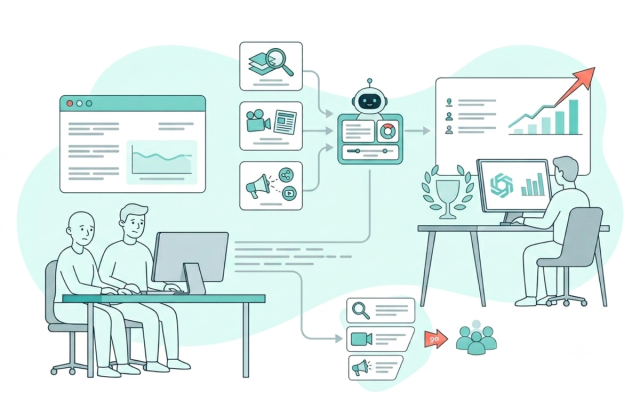
That typically means creating a unified operating environment where reporting, lead management, campaign execution, customer insights, and performance data work together.
Key priorities include:
- Standardized delivery frameworks
- Automated reporting and analysis
- Connected lead and pipeline visibility
- Cross-channel performance tracking
- AI-assisted operational workflows
This shift is driving interest in platforms and operating models that unify marketing execution rather than treating each function separately.
Solutions such as SproutMe reflect this evolution by helping agencies combine AI-powered execution, predictive optimization, and full-funnel visibility into a more scalable growth system.
The objective is not automation for its own sake. It is creating an operational foundation capable of supporting long-term growth.
Conclusion
Many agency growth challenges are not caused by sales, competition, or market conditions. They are caused by operational complexity that accumulates as agencies expand.
The agencies best positioned for the future will not necessarily be the largest. They will be the most operationally efficient.
As AI-driven marketing, automation, and search continue reshaping customer acquisition, agencies that simplify workflows, improve visibility, and build scalable systems will gain a meaningful advantage in both profitability and performance.
Growth is difficult. Growth with unnecessary complexity is far more expensive.
Growing Fast but Struggling to Scale?
If more clients are creating more bottlenecks, rising delivery costs, and increasing operational pressure, the problem may not be growth itself. It may be the systems supporting it.
SproutMe helps agencies replace fragmented workflows with AI-powered growth execution, predictive optimization, and full-funnel operational visibility. Build a scalable foundation designed for modern customer acquisition and AI-driven search experiences before complexity becomes your biggest cost.
FAQs
What are common agency growth challenges?
Operational complexity, inefficient workflows, rising acquisition costs, fragmented reporting, talent management, and maintaining profitability while scaling are among the biggest challenges agencies face.
How does complexity affect performance?
It slows execution, increases delivery costs, reduces visibility across teams, creates reporting inefficiencies, and limits an agency's ability to scale profitably.
Why is operational efficiency important?
Operational efficiency allows agencies to serve more clients, improve margins, deliver consistent results, and scale without significantly increasing overhead.
How can AI reduce operational complexity?
AI can automate reporting, streamline workflows, improve forecasting, support campaign optimization, and provide faster access to performance insights across marketing channels.
How can agencies scale without complexity?
Building standardized processes, centralizing data, integrating systems, and adopting AI-powered operational workflows can help agencies grow while maintaining efficiency.



Get a complimentary audit to uncover AI opportunities hidden in your data.
Put these strategies to work