Why Are My Property Inquiries So Low Despite Heavy Marketing Spend?


Real estate businesses rarely struggle because they aren't spending enough on marketing. More often, they're spending heavily across Google Ads, Meta, listing portals, and remarketing campaigns without seeing a proportional increase in inquiries.
The challenge is that buyer behavior has changed. Property decisions are now influenced by dozens of interactions across search, social media, video content, reviews, AI assistants, and local research. More visibility doesn't automatically translate into more leads.
If inquiries remain low despite consistent investment, the issue is usually somewhere within the funnel itself.
Optimizing for Activity, Not Buyer Intent
Many marketing reports highlight clicks, impressions, reach, and website traffic. These metrics indicate exposure, but they don't necessarily indicate buying intent.
Consider two campaigns. One generates 10,000 website visits and 50 inquiries. Another drives 3,000 visits and 120 inquiries. The second campaign is likely creating far more business value despite generating less traffic.
This is where many real estate marketing strategies fall short. Advertising platforms naturally optimize toward the easiest action. Getting someone to click is far easier than getting them to schedule a site visit or submit an inquiry.
An effective automated AI ads agency focuses on behavioral signals that indicate genuine interest, not just engagement. Actions such as repeat visits, brochure downloads, virtual tour engagement, and property comparisons often reveal stronger purchase intent than traffic volume alone.
Your Targeting May Be Too Broad
A common assumption in real estate advertising is that larger audiences create more opportunities. In reality, broader targeting often reduces efficiency.
A luxury residential project, for example, may be shown to investors, renters, first-time buyers, and general property browsers simultaneously. While reach increases, relevance decreases.
Modern AI-driven advertising systems take a different approach. Instead of relying primarily on demographics, they evaluate behavioral patterns and intent signals across multiple touchpoints. This allows campaigns to identify prospects who are actively researching, comparing, and moving closer to a purchase decision.
The result is often fewer leads on paper but significantly higher lead quality. For most developers, that's a far better outcome than filling the CRM with unqualified inquiries.
The Real Problem Often Starts After the Click
Low inquiry volume is frequently blamed on advertising performance. However, many conversion issues appear after the prospect arrives on the website.
A buyer clicks an ad expecting clarity and confidence. Instead, they encounter slow-loading pages, incomplete project information, generic messaging, or lengthy forms.
Every point of friction reduces conversion probability.
According to Google research, page experience continues to influence user engagement and conversion behavior. Even well-targeted campaigns struggle when the post-click experience creates uncertainty or unnecessary effort.
This is why full-funnel optimization matters. Generating traffic is only one part of the equation. The experience between the first click and the inquiry submission often determines campaign profitability.
As search behavior evolves, visibility challenges can also contribute to lower inquiry volume. Many real estate businesses are discovering that prospects increasingly research projects through AI-powered search experiences before ever reaching a website. Understanding why your real estate business may be invisible in AI search results can reveal additional gaps affecting lead generation performance.
Trust Drives Conversions in Real Estate
Property purchases involve significant financial and emotional commitments. Buyers rarely convert after seeing a single advertisement.
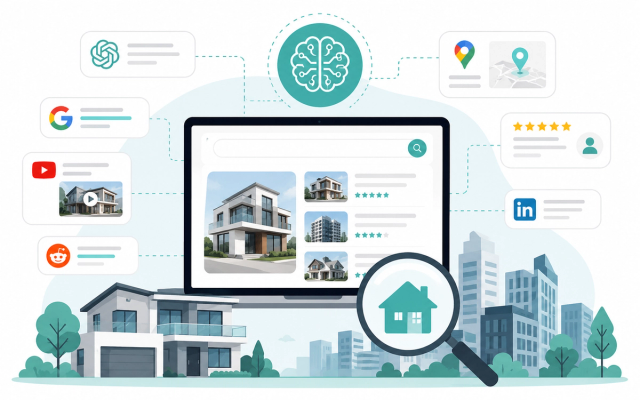
Before submitting an inquiry, many prospects compare developers, read reviews, watch walkthrough videos, evaluate neighborhoods, and seek validation from multiple sources. AI-powered search tools are accelerating this behavior by helping users gather information without visiting dozens of websites.
For example, a buyer may ask ChatGPT:
"Which areas offer the best long-term appreciation potential?"
Or:
"What should I evaluate before investing in a new residential project?"
The businesses that consistently appear throughout these research journeys build trust faster than competitors relying solely on paid traffic.
This is why modern lead generation requires more than media buying. An experienced AI marketing agency focuses on the entire decision journey, combining paid media, content strategy, AI visibility, reputation management, and conversion optimization into a unified growth system.
Cost Per Lead Isn't the Metric That Matters
Many real estate teams celebrate low cost-per-lead numbers. Unfortunately, low-cost leads often become expensive sales opportunities.
The better question is whether those leads are qualified.
High-performing marketing teams increasingly evaluate:
- Cost per qualified lead
- Cost per site visit
- Cost per booked consultation
- Cost per closed sale
This shift changes how campaigns are optimized. Instead of maximizing lead volume, marketing becomes focused on revenue outcomes.
AI-powered marketing systems are particularly effective here because they continuously learn which audiences, messages, and channels contribute to actual business results rather than superficial engagement metrics.
Conclusion
Low property inquiries are rarely caused by insufficient marketing spend. More often, they stem from broad targeting, weak conversion experiences, poor lead quality, fragmented buyer journeys, or an overreliance on vanity metrics.
As customer acquisition becomes increasingly data-driven, successful real estate businesses are moving beyond traditional campaign management and adopting more intelligent growth systems.
Working with an automated AI ads agency allows businesses to improve targeting precision, optimize conversion pathways, strengthen visibility across modern search experiences, and focus on the metrics that directly influence revenue.
The goal is not more traffic.
The goal is more conversations with qualified buyers.
Frequently Asked Questions
Traffic and inquiries measure different things. Many visitors may be researching the market without immediate purchase intent. Improving targeting and conversion experiences often increases inquiry rates more effectively than increasing traffic.
Yes. AI-powered advertising systems analyze behavioral data, engagement patterns, and conversion signals to identify audiences more likely to become qualified leads.
Metrics such as cost per qualified lead, site visit bookings, consultation requests, and closed sales provide a more accurate picture of marketing performance.
Buyers increasingly use AI-powered search tools to research neighborhoods, developers, and investment opportunities before contacting businesses. Strong visibility across these channels can influence inquiry volume.
An automated ai ads agency uses predictive optimization, machine learning, and cross-platform performance analysis to improve lead quality, conversion efficiency, and overall marketing ROI.
Get a complimentary growth audit from SproutMe and discover how AI-powered targeting, conversion optimization, and full-funnel marketing systems can help turn more of your existing traffic into qualified opportunities.



Get a complimentary audit to uncover AI opportunities hidden in your data.
Put these strategies to work